How VerifyAtlas uses machine learning, behavioral signals, and continuous research to solve what domain blacklists can't.
1. Introduction: The Problem Costing Your Business Thousands
Every day, fake users are eating into your revenue. They sign up for free trials they never intend to pay for. They create accounts to spam your community. They pollute your CRM with contacts that will never convert. They inflate your analytics with numbers that look good on dashboards but mean nothing for your bottom line.
And increasingly, the primary weapon these fake users wield is the disposable email address.
A disposable email address—also called a temporary email, throwaway email, or temp-mail—is an email address designed to exist for minutes, hours, or days, then vanish. These addresses are created by specialized services that exist solely to provide users with short-lived inboxes for receiving a single confirmation email, a verification code, or a download link. Once that single purpose is served, the address becomes useless. The user moves on. Your business is left holding the bag.
Why Do Fake Emails Hurt Your Business?
The damage caused by disposable email addresses is far more extensive than most organizations realize. It operates on multiple levels simultaneously, creating compounding costs that erode profitability and operational efficiency.
- Wasted Marketing Spend. When you pay for email marketing campaigns, every disposable address on your list represents money thrown away. You're paying your email service provider per contact. You're paying for the creative work that goes into each campaign. You're paying for the infrastructure that sends those emails. And every single one of those emails to a disposable address will bounce, be ignored, or simply disappear into the void. Your open rates drop. Your click-through rates plummet. Your sender reputation suffers. And your marketing team spends hours trying to optimize campaigns that were doomed from the start because the audience wasn't real.
- Polluted Analytics. Data-driven decision making is the backbone of modern business. But data is only as valuable as its accuracy. When 15% of your signups use disposable emails, your conversion funnel becomes a fiction. Your customer acquisition cost calculations become meaningless. Your lifetime value projections become fantasies. You might think a particular marketing channel is underperforming when in reality it's just attracting more fake users. You might think a product feature is resonating when it's actually just being abused by throwaway accounts. Clean data is the foundation of good decisions, and disposable emails are poison in that foundation.
- Fraud and Abuse. Free trial abuse is perhaps the most direct financial impact. A user signs up with a disposable email, consumes a free trial, then repeats the process with a new disposable address. They never pay, but they consume resources, bandwidth, support time, and infrastructure capacity. For SaaS companies, this can represent a significant percentage of total compute costs. For marketplaces, fake accounts enable review manipulation, spam listings, and fraudulent transactions. For communities, disposable emails enable trolling, harassment, and content spam at industrial scale.
- Support Burden. Fake accounts create real support tickets. Users who signed up with disposable emails forget which temporary address they used, can't access their accounts, and contact your support team. Your team wastes time troubleshooting issues for users who never intended to be real customers in the first place. The time spent on these tickets is time not spent on legitimate customers with real problems.
- Regulatory and Compliance Risk. In an era of GDPR, CCPA, and increasingly strict data protection regulations, maintaining accurate user data isn't just good business—it's often legally required. When you can't contact users about data breaches, privacy policy updates, or account issues because their email address no longer exists, you create compliance gaps that could expose your organization to significant liability.
- Database Bloat. Every fake signup adds rows to your database. Over time, this bloats your infrastructure, slows your queries, increases your backup costs, and complicates your data architecture. The cumulative effect of millions of fake records is a tax on your entire technical stack.
Why Is Disposable Email Becoming Harder to Detect?
The landscape of disposable email has evolved dramatically over the past decade. What was once a niche tool used by privacy-conscious individuals has become an industrial-scale infrastructure operated by sophisticated providers who understand exactly how detection systems work and actively work to evade them.
The first generation of disposable email services was relatively simple. A provider might operate a
single domain—something obvious like mailinator.com or guerrillamail.com. They might offer a
handful of alternative domains. Detection was straightforward: maintain a list of known disposable
domains and check against it. This approach worked because the attack surface was small and static.
Today's disposable email ecosystem is entirely different. Modern providers operate with the sophistication of legitimate email services. They register hundreds or thousands of domains simultaneously. They rotate domains on a schedule—taking down old ones and bringing up new ones before detection systems can catch up. They use domain generation algorithms that create new addresses programmatically. They register domains through privacy-protecting registrars, use diverse hosting infrastructure, and mimic the technical configuration of legitimate email providers.
The economics have shifted too. Domain registration costs have plummeted. Bulk registration discounts mean a provider can register 10,000 domains for pennies each. Infrastructure-as-a-service platforms make it trivial to spin up mail servers across multiple continents. The barrier to entry for operating a disposable email service has never been lower, which means the number of providers has exploded.
Perhaps most importantly, the intent behind disposable email usage has broadened. It's no longer just privacy enthusiasts and occasional spammers. Entire underground economies have developed around disposable emails. There are services that sell "aged" disposable accounts. There are marketplaces where you can buy bulk verified accounts for specific platforms. There are automated tools that cycle through disposable addresses to exploit free trials, scrape content, or manipulate ratings. The scale and sophistication of abuse has reached a point where simple detection methods are hopelessly outmatched.
Why Do Traditional Approaches Fail Today?
Traditional disposable email detection was built for a different era. It was designed when the problem was small, the providers were few, and the domains were static. The fundamental assumption underlying traditional approaches is that you can know in advance which domains are disposable and which are not. You build a list. You check against it. Problem solved.
This assumption was never perfectly true, but it was close enough to be useful for many years. Today, it is catastrophically wrong. The half-life of a disposable domain—the time between when a domain is registered and when it appears on a blacklist—can be measured in hours. By the time a domain makes it onto a public blacklist, the provider has already registered five more. The blacklist is always chasing the problem from behind, and the gap is widening.
Traditional approaches also fail because they treat email verification as a static, one-time check. In reality, the disposable email landscape is a dynamic, adversarial environment. Providers are actively trying to evade detection. They study how verification APIs work. They test their domains against popular services before deploying them at scale. They adapt their infrastructure to mimic legitimate providers. A detection system that doesn't evolve in response to these adaptations is a detection system that becomes less effective every single day.
This is exactly why we built VerifyAtlas. We were tired of seeing businesses lose money, waste resources, and make bad decisions because their email verification was stuck in 2015. We built a system that doesn't just check lists—it understands behavior. And that changes everything.
2. How Most Email Verification APIs Actually Work (And Why They're Falling Behind)
To understand why VerifyAtlas is different, you first need to understand how the majority of email verification APIs on the market actually function. This isn't a criticism of any particular service—many of these APIs were built by competent engineers solving the problem as it existed at the time. The issue is that the problem has changed, and the architecture hasn't.
The typical email verification pipeline looks something like this:
Step 1: Syntax Validation
The API first checks whether the email address is structurally valid. Does it contain an @ symbol? Is the local part (before the @) properly formatted? Is the domain part (after the @) a valid domain name?
This step is necessary and uncontroversial. An email like not-an-email fails here. But syntax
validation tells you almost nothing about whether an address is disposable. A perfectly formatted
email address can be entirely disposable, and a syntactically unusual address can be completely
legitimate. Syntax validation is a hygiene check, not a detection mechanism.
Step 2: Popular Provider Whitelist
Next, the API checks whether the domain belongs to a well-known, trusted email provider. Is it gmail.com? outlook.com? yahoo.com? icloud.com? proton.me? If the domain matches a whitelist of major providers, the API typically returns a "clean" result immediately.
This step makes sense from a user experience perspective. The vast majority of legitimate email addresses come from major providers. If you can quickly identify these as safe, you avoid false positives and reduce processing time. But this step tells you nothing about the hard problem—detecting disposable emails from unknown or obscure domains. It's the easy part, and every API does it essentially the same way.
Step 3: Disposable Domain Blacklist
If the domain isn't on the whitelist, the API checks whether it appears on a blacklist of known disposable email domains. This is the core detection mechanism for most traditional APIs. The blacklist might contain 5,000 domains, or 50,000, or even 100,000. The API does a simple lookup: is this domain in the list? If yes, it's disposable. If no, it's clean.
This approach was perfectly reasonable years ago. When disposable email services operated a small number of static domains, a blacklist was an effective and efficient solution. The computational cost is minimal—a hash table lookup is essentially instantaneous. The implementation is simple. The results are deterministic and easy to explain.
The problem, as we'll explore in the next section, is that this model breaks down completely when domains are created faster than they can be added to blacklists.
Step 4: Optional MX Lookup
Some APIs add an MX (Mail Exchange) record lookup as an additional step. They query the domain's DNS records to see if it has mail servers configured. The theory is that legitimate domains will have proper MX records, while fake or abandoned domains might not.
As we'll see in Section 4, this sounds smart but doesn't actually solve the disposable email problem. It's a common misconception that MX checking provides meaningful intelligence about whether a domain is disposable. In reality, it provides very little.
Step 5: Result
The API returns a verdict: disposable or clean. Sometimes it includes additional metadata like whether the domain is a role-based email address (admin@, support@, etc.) or whether it uses a plus alias (user+tag@gmail.com). But the core verdict is binary and based almost entirely on whether the domain appeared in a blacklist.
This pipeline is logical, clean, and easy to understand. It was also effective for a significant period of time. Engineers built these systems, they worked well enough, and they became the industry standard.
But here's the critical problem: the disposable email providers evolved, and the detection systems didn't. What was once a reasonable architecture has become a liability. And every day you rely on it, more fake users slip through.
3. The Problem with Domain Blacklists: Why You're Always Playing Catch-Up
Domain blacklists are the foundation of traditional disposable email detection, and they are failing. To understand why, let's examine the economics and operational dynamics of modern disposable email providers—and why this means your current verification API is leaving you exposed.
The Domain Creation Arms Race
Consider how a modern disposable email provider operates. They don't register one domain and operate it for years. They register domains in bulk, operate them for a period of time, then rotate to new ones. The lifecycle looks something like this:
Phase 1: Registration
The provider uses automated tools to register hundreds or thousands of domains through various registrars. They might use different registrars to avoid patterns. They might use privacy protection services to hide ownership. They might register domains with names that sound legitimate—combinations of common words, random strings, or names that mimic real services.
Phase 2: Deployment
The provider configures mail infrastructure for these domains. They set up MX records, configure mail servers, and ensure the domains can receive email. This might happen within hours of registration.
Phase 3: Usage
The provider makes these domains available to users, either through a web interface or an API. Users sign up for services using addresses on these domains. The provider's infrastructure receives the verification emails.
Phase 4: Rotation
After a period of time—days, weeks, or months—the provider begins to retire these domains. They might stop renewing them. They might redirect them to new domains. They register a fresh batch of domains and the cycle repeats.
The scale of this operation is staggering. A single provider might create 100 domains one week, 500 the next, 5,000 the month after, and 50,000 in a major expansion. The cost of domain registration has dropped to the point where operating thousands of domains is economically viable even for relatively small operations. Bulk registration APIs, automated DNS management, and cloud infrastructure have made this process almost entirely automated.
Why Blacklists Can't Keep Up
The fundamental mathematical problem with blacklists is that they are reactive, and the thing they're reacting to is being created faster than they can react.
Consider the timeline:
- T+0 hours: A disposable email provider registers a new domain.
- T+2 hours: The provider configures mail infrastructure and makes the domain available to users.
- T+4 hours: Users begin signing up for services using addresses on this domain.
- T+12 hours: Some of those signups trigger abuse reports or manual review by platform operators.
- T+24 hours: A platform operator identifies the domain as disposable and submits it to a blacklist.
- T+48 hours: The blacklist maintainer reviews the submission, verifies it, and adds it to the database.
- T+72 hours: The updated blacklist propagates to APIs that consume it.
By the time the domain appears on a blacklist, it may have already been used to create thousands of fake accounts. And more importantly, the provider has already registered dozens or hundreds of replacement domains that aren't on any blacklist yet.
This is why VerifyAtlas doesn't rely on blacklists as its primary detection mechanism. We use them as one layer among many, but we don't depend on them. Our neural network can identify disposable domains within hours of their registration—before they've been added to any blacklist, before they've been reported by any user, before they've been seen by any other detection system.
Domain Lifecycle Complexity
The problem isn't just speed—it's also the complexity of domain lifecycles in the disposable email ecosystem.
- Domains rotate. Providers don't use the same domains indefinitely. They cycle through them to avoid accumulation on blacklists. A domain that was legitimate yesterday might be disposable today, and a domain that was disposable last month might have been abandoned and later purchased by a legitimate business.
- Domains expire. When a provider stops renewing a domain, it doesn't immediately disappear. It enters a grace period, then a redemption period, then it becomes available for registration again. During this limbo, the domain might still appear on blacklists even though it's no longer operated by a disposable provider. Conversely, a legitimate domain that expires and is purchased by a disposable provider won't be on any blacklist initially.
- Domains are abandoned. Providers sometimes register more domains than they end up using. These abandoned registrations create noise in the ecosystem—domains that were intended to be disposable but never actually received email. They might appear in leaked lists or be flagged by heuristic systems, creating false signals.
- Providers constantly create new domains. The most important dynamic is the continuous creation of new domains. Every day, new disposable domains come into existence that have never been seen before by any detection system. These are the domains that traditional blacklist-based APIs will invariably miss. And these are precisely the domains that sophisticated abusers seek out, because they know these domains have the highest chance of bypassing detection.
The Coverage Problem
Even if we ignore the speed issue, blacklists face a coverage problem. How many disposable domains exist in the world at any given moment? Tens of thousands? Hundreds of thousands? Millions? No blacklist can possibly cover all of them, because many are private, obscure, or operated by providers that fly under the radar.
There are disposable email services that operate only in specific languages, targeting users in particular countries. There are services that exist as invite-only communities. There are services that are technically capable of receiving email but primarily used for other purposes. There are corporate email systems that have been compromised and repurposed as disposable infrastructure. The surface area is vast and largely invisible to blacklist maintainers.
A blacklist, no matter how large, is always a subset of the actual problem. It can never be complete. And the more complete it tries to become, the more maintenance overhead it creates, and the slower it becomes to update.
The Maintenance Burden
Maintaining a high-quality blacklist is surprisingly difficult. It requires continuous human effort to:
- Monitor new disposable email services as they appear
- Verify submissions from users and platforms
- Remove false positives when legitimate domains are incorrectly flagged
- Update entries when domains change hands or purposes
- Deduplicate entries when multiple sources report the same domain
- Validate that listed domains are still actually disposable
This work doesn't scale linearly. As the blacklist grows, the verification and maintenance burden grows faster. A blacklist of 100,000 domains requires far more than 10x the effort of a 10,000-domain list, because the long tail of obscure domains requires more research to verify, and the rate of false positives increases as you expand into edge cases.
Many blacklist maintainers are volunteers or small teams. They cannot possibly keep pace with industrial-scale disposable email operations. The economics are fundamentally unfavorable: it takes minutes to register a domain and hours to properly verify and blacklist it.
VerifyAtlas solves this by making blacklists secondary. Our primary detection doesn't depend on human verification of individual domains. Our neural network learns patterns from hundreds of thousands of examples and generalizes to new domains automatically. We don't need to manually verify every new disposable domain because our model understands what disposable domains look like.
4. Why MX Records Don't Solve the Problem
Among developers and technical decision-makers, there's a common misconception that MX record lookup is a sophisticated detection technique. The thinking goes: if we check whether a domain actually has mail servers configured, we can distinguish legitimate email providers from fake ones. If a domain has proper MX records, it must be a real email service, right?
This sounds logical. It is also wrong. And if your current API relies on MX checking as a primary defense, you're not getting the protection you think you are.
What MX Records Actually Tell You
An MX record is a DNS record that specifies which mail servers are responsible for receiving email
on behalf of a domain. When you send an email to user@example.com, your mail server looks up the
MX records for example.com to find out where to deliver the message.
What MX records tell you:
- Which hostnames are configured to receive mail for the domain
- The priority order of those mail servers (if multiple are configured)
What MX records do NOT tell you:
- Whether the domain is operated by a disposable email provider
- The reputation or intent of the domain owner
- Whether the mail server will actually deliver messages to a real inbox
- Whether the domain is legitimate, suspicious, or malicious
- How long the domain has been in operation
- Who actually owns or operates the domain
An MX record is a technical configuration detail. It tells you that someone configured DNS records to receive email. That's it. It provides no semantic information about the nature of that email service.
The Shared Infrastructure Problem
Here's where the MX misconception really falls apart. Modern disposable email providers frequently share mail infrastructure with each other and, in some cases, with legitimate services.
Consider a scenario: A disposable email provider owns the mail server mail1.example.com. This
server is configured as the MX target for 1,000 different domains operated by the provider. When you
look up the MX record for any of these 1,000 domains, you see mail1.example.com.
What have you learned? You've learned that these 1,000 domains use the same mail server. You have not learned:
- That this mail server is operated by a disposable email provider
- That the 1,000 domains are disposable email domains
- That this infrastructure is shared with other providers
- Whether any of these domains are legitimate
In fact, multiple temporary email providers often share the same underlying infrastructure. They might use the same hosting provider, the same mail server software, or even the same physical servers. When you see an MX record pointing to a particular host, you might be looking at infrastructure shared by five different disposable providers, plus a legitimate bulk email service, plus a small business that happens to use the same hosting company.
The MX record tells you where mail goes. It tells you nothing about why it goes there or who controls the destination.
MX Records Look the Same
From a purely technical standpoint, the MX configuration of a disposable email provider often looks nearly identical to that of a legitimate small email provider or a corporate mail system. Both will have MX records pointing to properly configured mail servers. Both will have valid DNS records. Both will be able to receive email.
Without additional context—knowing that the mail server is operated by a particular provider, understanding the reputation of that provider, analyzing patterns across multiple domains—an MX lookup provides almost no discriminatory power for detecting disposable emails.
Some developers try to get clever with MX analysis. They might check whether the MX target is a known disposable infrastructure host. But this is just blacklist logic applied to MX targets instead of domains, with all the same problems. They might check whether the MX record points to an IP associated with known disposable providers. But IP addresses are even more fluid than domains, and shared hosting means the same IP might serve hundreds of completely unrelated domains.
The False Confidence Trap
Perhaps the most dangerous aspect of MX-based detection is that it creates false confidence. An API that performs MX lookups can claim to do "deep infrastructure analysis" or "server verification." This sounds impressive to non-technical stakeholders. It suggests a level of sophistication that doesn't actually exist.
In reality, MX lookup is a trivial DNS query that takes milliseconds and provides almost no actionable intelligence for disposable email detection. It's not useless—it can catch completely non-functional domains, and it can be a component of a larger analysis pipeline—but it is not a detection mechanism on its own.
At VerifyAtlas, we do check MX records. But we treat them as one minor signal among hundreds—not as a primary defense. Our real detection power comes from analyzing the full technical fingerprint of a domain: its registration patterns, DNS behavior, hosting characteristics, mail configuration, naming patterns, and provider relationships. MX records are a tiny piece of a much larger puzzle.
When an API tells you that a domain "has valid MX records" as evidence that it's clean, what they're really saying is "this domain can receive email, which tells us nothing about whether it's disposable." The presence of MX records is necessary for a domain to function as an email provider, but it is not sufficient to establish legitimacy.
5. Why Whitelists Are Easy (And Why Every API Gets This Right)
If there's one part of email verification that every API gets right, it's the whitelist of popular providers. This is almost comically straightforward, yet it's worth examining because it highlights just how lopsided the difficulty curve is in email verification—and where the real value lies.
Every email verification API on the market maintains a list of well-known, trusted email providers. This list includes:
- Gmail (gmail.com, googlemail.com)
- Outlook/Hotmail (outlook.com, hotmail.com, live.com)
- Yahoo (yahoo.com, ymail.com)
- Apple iCloud (icloud.com, me.com)
- Proton Mail (proton.me, protonmail.com)
- Microsoft 365 / Exchange Online (various custom domains)
- Major corporate providers (various)
These providers represent the vast majority of legitimate email addresses in the world. When an email uses one of these domains, the API can immediately return a "clean" result with high confidence. There's no innovation required here. No machine learning. No sophisticated analysis. Just a list that everyone maintains essentially the same way.
The reason whitelists are easy is that these providers are:
- Stable: They've been operating for years or decades and aren't going anywhere
- Well-known: Their domains are universally recognized
- Legitimate: They have established reputations and business models that don't involve disposable email
- Large: They serve hundreds of millions or billions of users
- Transparent: They operate publicly with known infrastructure and policies
Checking against a whitelist of popular providers is table stakes. It's the first thing any email verification API does, and it requires almost no maintenance. Google isn't going to suddenly start offering disposable emails. Yahoo isn't going to pivot to temporary inboxes. These domains are constants in the equation.
But here's the critical insight: the easy part isn't the valuable part. The whitelist solves the problem that didn't need solving. Everyone already knows that Gmail addresses are legitimate. The real challenge, the part that actually matters for protecting your business, is everything that isn't on the whitelist. It's the long tail of unknown domains, obscure providers, and newly registered addresses that could be anything from a small business email to a sophisticated disposable operation.
This is where VerifyAtlas separates from the pack. While we handle whitelists with the same reliability as any other API, our real value is in the unknown domain space—the area where traditional APIs fail and where our neural network excels.
When you evaluate an email verification API, don't ask how well they detect Gmail. Ask how well they
detect new-temp-email-74291.com registered 18 hours ago by a provider you've never heard of.
That's where the value is. And that's where VerifyAtlas wins.
6. The Real Challenge: What Your Current API Is Missing
We've established that whitelists are easy, blacklists are falling behind, and MX records don't provide meaningful intelligence. So what is the actual hard problem in disposable email detection? And more importantly, why does it matter for your business?
The hard part isn't detecting Gmail. The hard part isn't detecting Mailinator. The hard part is
detecting new-temp-email-74291.com registered 18 hours ago, before anyone else knows it exists.
This is the core challenge that separates effective detection from ineffective detection. It's the difference between looking backward and looking forward. Between reactive and proactive. Between playing defense and playing offense.
The Unknown Domain Problem
Consider what happens when a user signs up with an address like user@new-temp-email-74291.com. A
traditional blacklist-based API performs the following logic:
- Is it syntactically valid? Yes.
- Is it a popular provider? No.
- Is it on the disposable blacklist? No—this domain was registered yesterday and hasn't been added to any blacklist yet.
- Optional MX check: It has MX records pointing to some mail server.
- Verdict: Clean.
But this domain is operated by a disposable email provider. It was registered automatically, configured to receive mail, and made available to users within hours. It will be used to create fake accounts across dozens of platforms. It will be abandoned within weeks. And it will never appear on a public blacklist while it's actively being used for abuse.
The traditional API has failed. Not because of a bug, not because of poor maintenance, but because of a fundamental architectural limitation. It can only detect what it has already been told about. It has no mechanism for recognizing new threats.
VerifyAtlas doesn't have this limitation. When our system encounters the same domain, our neural network analyzes its characteristics—registration timing, naming patterns, DNS configuration, hosting choices, mail server setup, network topology—and recognizes the signature of a disposable provider even though this specific domain has never been seen before. We flag it as suspicious with high confidence, while traditional APIs are still saying "clean."
The Signal-to-Noise Problem
The unknown domain space is vast. Millions of domains are registered every day. Most of them are completely legitimate—businesses launching websites, developers setting up projects, individuals starting blogs. A tiny fraction are disposable email domains. The challenge is distinguishing the signal (disposable domains) from the noise (legitimate domains) without prior knowledge.
This is why simple heuristics fail. You might think "newly registered domains are suspicious," but most newly registered domains are legitimate businesses. You might think "domains with random-looking names are suspicious," but many legitimate services use generated domain names. You might think "domains hosted on cheap VPS providers are suspicious," but millions of legitimate small businesses use the same hosting.
Any single signal is weak. Any simple rule generates massive false positives or massive false negatives. The problem requires looking at dozens of signals simultaneously, understanding their complex interactions, and making probabilistic judgments rather than binary ones.
This is exactly what VerifyAtlas does. Our neural network evaluates hundreds of signals across multiple dimensions and learns the complex, nonlinear relationships that distinguish disposable providers from legitimate ones. It doesn't rely on any single rule or heuristic. It builds a holistic understanding.
The Speed Requirement
Detection isn't just about accuracy—it's about speed. A domain that evades detection for 24 hours might be used to create thousands of fake accounts. By the time it makes it onto a blacklist, the damage is done. Effective detection needs to identify suspicious domains within hours of their registration, before they've been widely abused.
This speed requirement rules out many potential detection mechanisms. You can't wait for abuse reports. You can't wait for manual verification. You can't wait for the domain to appear on multiple platforms. You need to make a judgment based on whatever information is available at the moment of registration—DNS configuration, hosting patterns, naming conventions, infrastructure choices—and that judgment needs to be accurate enough to be actionable.
VerifyAtlas is designed for speed. Our API responds in milliseconds. Our neural network makes real-time assessments of new domains. We don't need to wait for human verification or blacklist updates. We detect threats as they emerge, not after they've done damage.
The Adversarial Nature
Perhaps the most underappreciated aspect of this problem is that it's adversarial. Disposable email providers are not passive targets. They are active opponents who study detection systems and adapt to evade them.
When a provider notices that their domains are being flagged, they change tactics. They might switch registrars. They might use different naming patterns. They might distribute their infrastructure across more hosting providers. They might implement technical configurations that mimic legitimate services more closely. They might deliberately register some domains that look legitimate to poison detection datasets.
This means that effective detection can't be static. It can't be a set of rules that worked last year. It needs to be a system that continuously learns, adapts, and improves as the opposition evolves. It needs to be intelligent in the same way that the providers are intelligent.
This is why VerifyAtlas is built on machine learning. Our models are continuously retrained on new data. As providers evolve, our detection evolves with them. We're not playing catch-up with a static blacklist. We're running an intelligence operation that stays ahead of the adversary.
7. Introducing VerifyAtlas: Layered Intelligence That Actually Works
Given everything we've discussed—the failure of blacklists, the limitations of MX records, the ease of whitelists, and the genuine difficulty of unknown domain detection—we built VerifyAtlas to be the detection system we wished existed.
We didn't want another blacklist API. We wanted intelligence. We wanted a system that understands behavior, not just names. We wanted detection that works today and will work even better tomorrow.
This is the VerifyAtlas approach: layered intelligence.
For the wider strategy behind this approach, read Why Signup Intelligence Should Go Beyond Email.
The VerifyAtlas Detection Pipeline
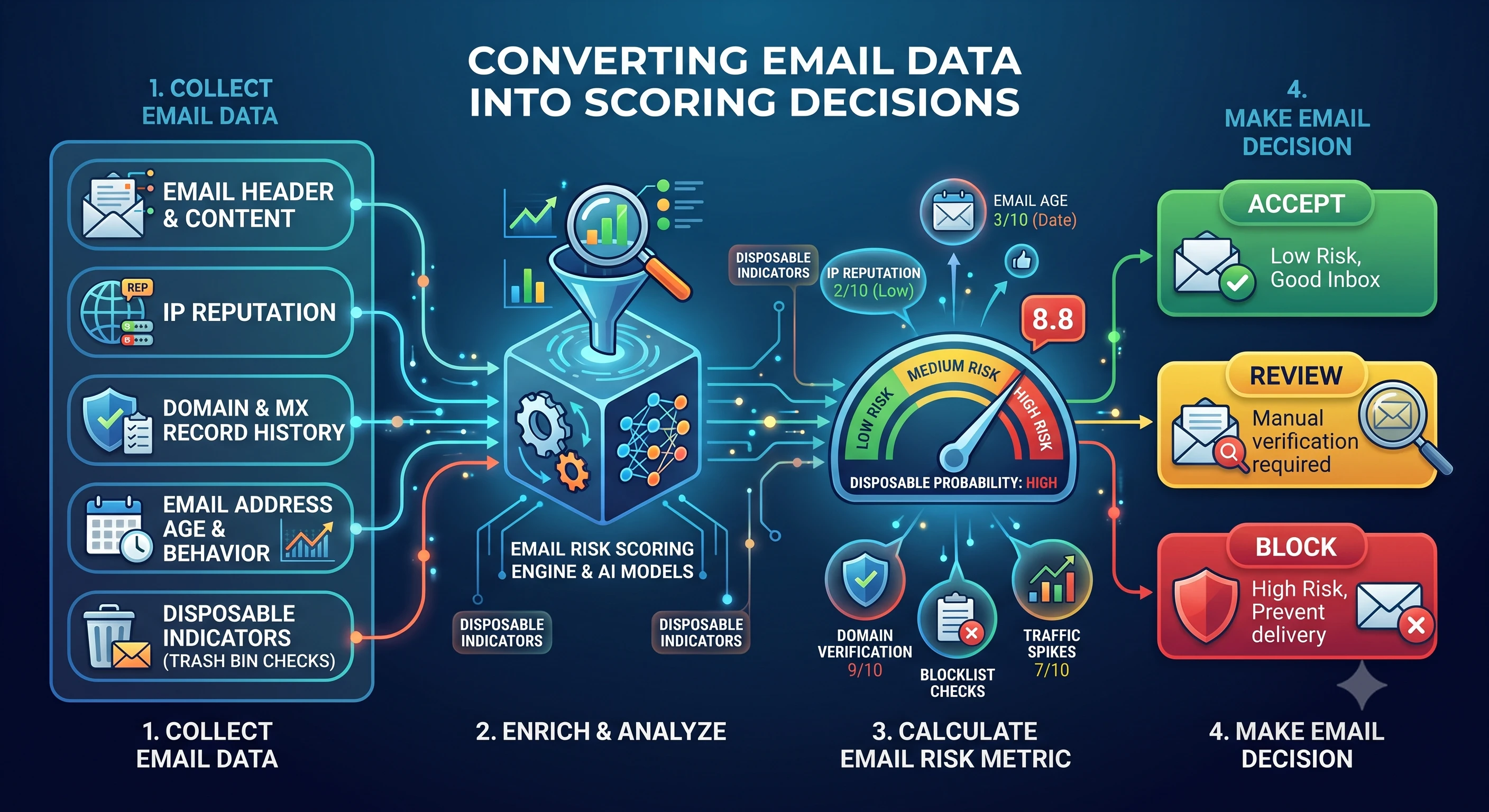
Our system analyzes every email address through multiple layers of detection, each designed to catch threats that other layers might miss:
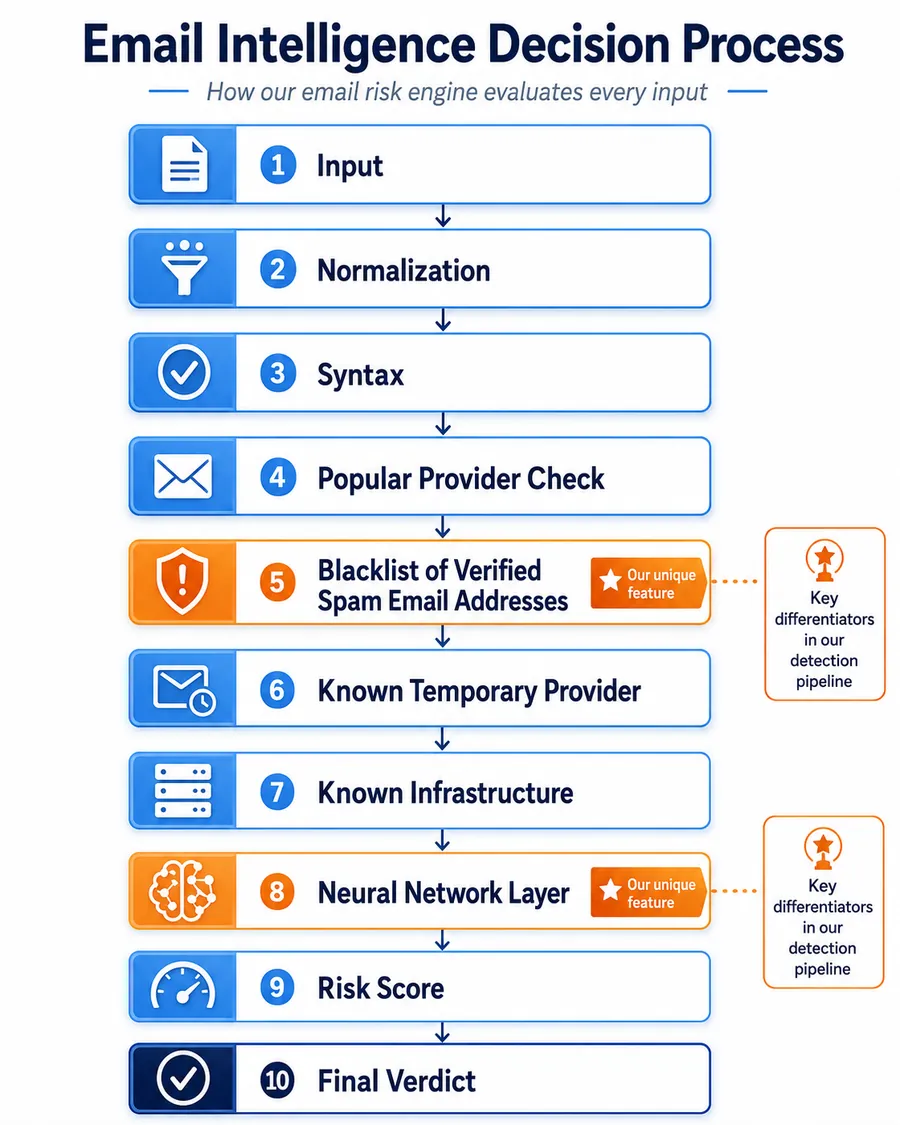
Let's walk through each layer:
- Normalization. Before any analysis begins, we normalize the input. This includes standardizing the email format, handling internationalized domain names, normalizing plus aliases, and preparing the input for consistent processing. Normalization ensures that variations in user input don't create false negatives or false positives.
- Syntax Validation. We verify that the email address conforms to RFC standards. This catches obvious garbage input and ensures that subsequent layers are working with valid data. As discussed earlier, this is necessary but not sufficient.
- Popular Provider Check. We maintain a whitelist of major, trusted email providers. If the domain matches a known legitimate provider, we can return a clean result with extremely high confidence. This is the fast path for the majority of legitimate addresses.
- Known Temporary Provider Detection. We maintain intelligence on known disposable email providers, including not just domain lists but provider profiles, infrastructure fingerprints, and behavioral patterns. This catches disposable addresses from providers we've already identified, even if they're using domains that haven't been widely reported yet.
- Known Infrastructure Analysis. We analyze the technical infrastructure behind the domain—hosting providers, mail servers, DNS configuration, SSL certificates, and network topology. This layer identifies when a domain is using infrastructure associated with disposable email operations, even if the domain itself is new.
- Neural Network Analysis. This is where VerifyAtlas fundamentally diverges from every other API on the market. Our neural network doesn't ask "Is this domain on a list?" It asks "Does this domain behave like a temporary email provider?" This is a completely different type of question, and it enables detection of domains that have never been seen before.
- Risk Score Generation. Rather than a binary disposable/clean verdict, we generate a continuous risk score from 0 to 100 that reflects our confidence in the assessment. This score incorporates signals from all previous layers, weighted by their reliability and relevance.
- Final Verdict. The risk score is translated into a final verdict with an associated confidence level. This might be "disposable with 95% confidence," "suspicious with 72% confidence," or "clean with 98% confidence." The verdict includes reasoning that explains which layers contributed to the assessment.
Why Layers Matter
Each layer in this pipeline serves a specific purpose and addresses a specific weakness of simpler approaches.
The whitelist layer provides speed and accuracy for the common case. The known provider layer catches obvious disposable addresses efficiently. The infrastructure layer detects patterns that span multiple domains. And the neural network layer handles the unknown—the new domains, the evolving providers, the threats that haven't been catalogued yet.
No single layer is sufficient on its own. The whitelist doesn't help with unknown domains. The blacklist doesn't help with new domains. The infrastructure analysis can be evaded by providers who distribute their hosting. The neural network needs the other layers to provide context and validation.
But together, these layers create a system that is dramatically more effective than any single technique. A domain that evades one layer is caught by another. A provider that changes their infrastructure is still caught by behavioral patterns. A completely new domain is still assessed by the neural network's understanding of what disposable providers look like.
The Philosophy That Drives Us
The fundamental philosophy behind VerifyAtlas is different from traditional detection. Traditional detection asks: "Do I know this domain?" VerifyAtlas asks: "What does this domain tell me about its nature?"
The first question is about memory. The second is about understanding. Memory can be complete and still fail when encountering something new. Understanding can generalize to situations that have never been seen before.
This is why we describe VerifyAtlas as an intelligence system rather than a database lookup service. We're not just checking lists. We're analyzing behavior, recognizing patterns, and making informed judgments about the nature of email infrastructure.
When you use VerifyAtlas, you're not getting a bigger blacklist. You're getting a smarter system. And that makes all the difference.
8. Why Machine Learning Changes Everything (And Why VerifyAtlas Leads the Market)
Machine learning is often discussed in technology marketing as a buzzword—a feature to check off on a comparison chart. But in the context of disposable email detection, machine learning represents a fundamental paradigm shift that changes what is possible. And VerifyAtlas is the only API that has fully embraced this shift.
From Memory to Understanding
The core conceptual difference between traditional detection and VerifyAtlas can be summarized in two questions:
- Traditional APIs: "Have I seen this domain before?"
- VerifyAtlas: "Does this domain behave like a temporary email provider?"
These are profoundly different questions. The first is a lookup. The second is an inference. The first requires prior knowledge. The second requires understanding.
When a traditional API encounters a domain it has never seen before, it has no basis for judgment. It can only say "I don't know" and default to "clean" (since false positives are generally more damaging than false negatives). This is why unknown domains from disposable providers slip through traditional detection constantly.
When VerifyAtlas encounters a domain it has never seen before, our neural network analyzes the domain's characteristics—how it was registered, how it's configured, where it's hosted, what patterns its name follows, how its DNS is structured—and compares these characteristics to what it has learned about disposable and legitimate providers. It makes an inference based on patterns, not just memory.
This is the difference between a security guard who only stops people on a specific list, and a security guard who understands what suspicious behavior looks like. The first guard is helpless against anyone not on the list. The second guard can recognize threats they've never encountered before.
VerifyAtlas is the second guard. And in the world of disposable email detection, that's the only kind of guard worth having.
Generalization: The Competitive Advantage
The power of machine learning in this context is generalization. A model trained on thousands of examples of disposable email providers learns the patterns that characterize these providers. It learns that disposable providers tend to register domains in bulk, use certain naming conventions, configure their DNS in particular ways, host their mail servers on specific types of infrastructure, and exhibit certain behavioral patterns.
When the model encounters a new provider that exhibits these same patterns, it recognizes the similarity even though it has never seen this specific provider before. It generalizes from what it has learned to what it hasn't seen.
This is exactly what traditional blacklists cannot do. A blacklist has no concept of similarity. A domain is either on the list or it isn't. There is no gradation, no inference, no pattern recognition.
This generalization capability is why VerifyAtlas catches threats that no other API can catch. It's not because we have a bigger database. It's because we have a deeper understanding.
Handling Evolution
The disposable email ecosystem is not static. Providers evolve their tactics. They change how they register domains, how they configure infrastructure, how they operate their services. A static set of rules or a static blacklist becomes less effective over time as providers adapt to evade it.
VerifyAtlas models are continuously retrained. As new providers emerge, as existing providers change tactics, as the landscape evolves, our models are updated with new training data. They learn new patterns and adjust their understanding of what disposable providers look like.
More importantly, our well-designed models can recognize evolutionary changes even before retraining. If a provider starts using a new registrar that the model hasn't seen before, but continues to exhibit all the other patterns of a disposable provider, the model can still make an accurate assessment. It understands that the combination of signals matters more than any individual signal.
While your current API becomes less effective every day, VerifyAtlas becomes more effective. That's the power of continuous learning.
Probabilistic Reasoning for Better Business Decisions
Another fundamental advantage of VerifyAtlas's machine learning approach is that it naturally produces probabilistic outputs rather than binary ones. Our neural network doesn't say "this is disposable" or "this is clean." It produces a confidence score—a probability that the domain is disposable.
This probabilistic output is enormously valuable for businesses. It allows for nuanced decision-making rather than crude blocking. A domain with 95% disposable confidence might be blocked automatically. A domain with 70% confidence might trigger additional verification steps. A domain with 40% confidence might be allowed but flagged for monitoring. A domain with 5% confidence can be accepted without concern.
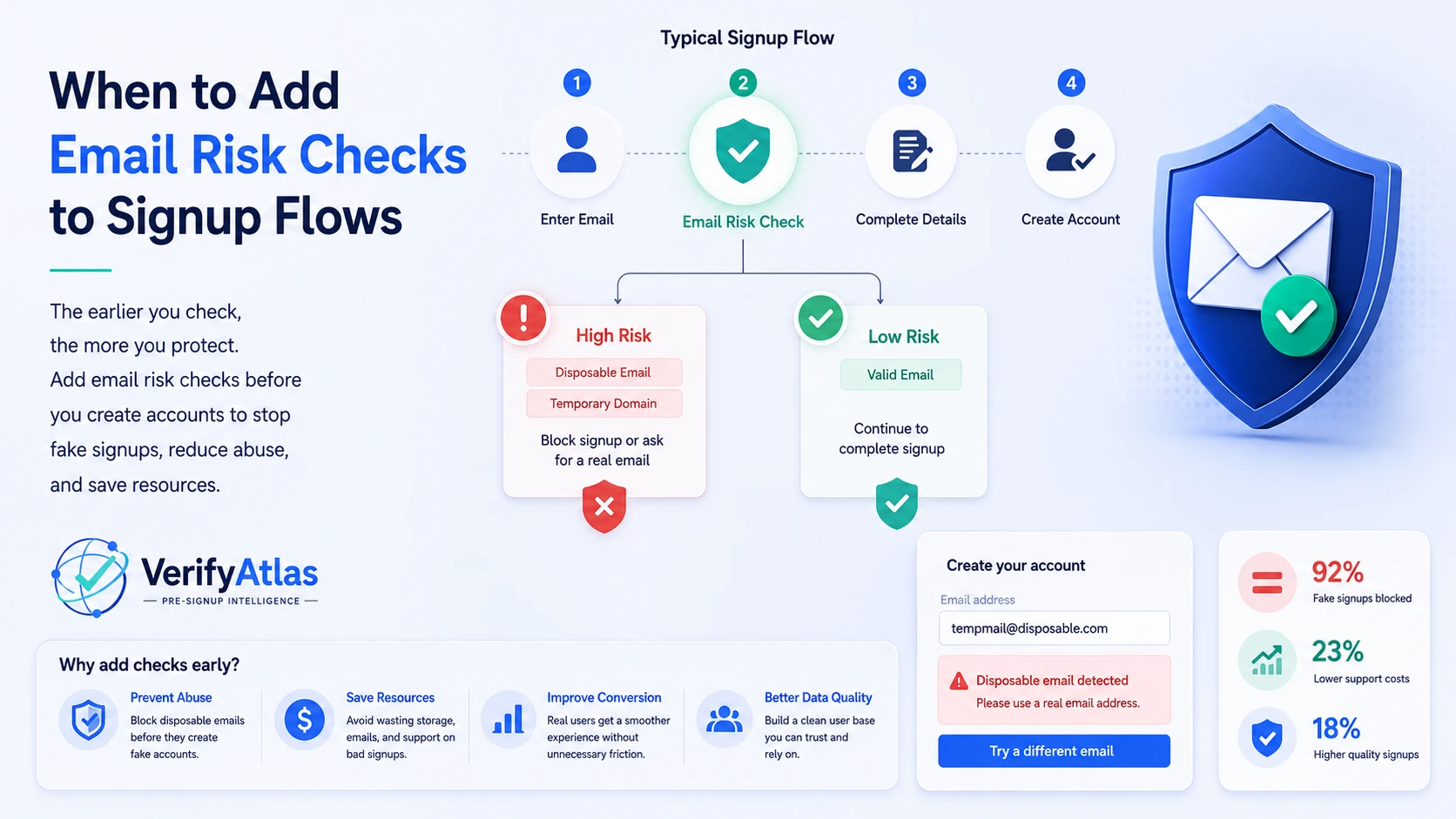
For implementation timing, see When to Add Email Risk Checks to Signup Flows.
Traditional binary detection forces a one-size-fits-all approach. VerifyAtlas enables risk-based decision making that adapts to your business's specific tolerance for false positives and false negatives.
You get control. You get nuance. You get decisions that match your business needs, not someone else's rigid rules.
9. Training Data: The Foundation That Makes VerifyAtlas Unbeatable
A machine learning system is only as good as the data it's trained on. This is a cliché in machine learning, but it's particularly true in the adversarial domain of disposable email detection, where the problem space is vast, constantly changing, and full of subtle distinctions.
At VerifyAtlas, our training data represents one of the most comprehensive collections of disposable email intelligence ever assembled for this purpose. It's not just big—it's meticulously curated, continuously updated, and specifically designed to train models that generalize to new threats.
Scale and Scope
Our training dataset includes:
- Over 300,000 temporary email samples. These are actual email addresses confirmed to be disposable, collected from a wide variety of sources including active disposable email services, abuse reports, honeypot accounts, and research partnerships. This isn't a list of domains—it's a diverse collection of addresses that captures the full range of how disposable emails are structured and used.
- Over 1 million mail infrastructure records. For each domain in our dataset, we maintain detailed records of its technical configuration: DNS records, MX configuration, hosting information, SSL certificates, WHOIS data, network topology, and more. This infrastructure data is crucial for training models to recognize the technical signatures of disposable providers.
- Continuously expanding negative examples. Machine learning requires balanced training data, which means we need not just examples of disposable emails but also examples of legitimate emails. Our dataset includes millions of confirmed legitimate addresses from diverse sources—corporate domains, personal domains, small business domains, educational institutions, and more. This ensures our model understands what legitimacy looks like across the full spectrum of the email ecosystem.
- Temporal coverage. Disposable email tactics have evolved significantly over the past decade. Our training data spans multiple years, capturing how providers have changed their approaches over time. This historical depth is essential for training models that understand evolution and can recognize both current and legacy patterns.
This isn't data that any competitor can easily replicate. It represents years of dedicated research, active monitoring, and careful curation. It's a competitive moat that protects the quality of our detection.
Continuous Retraining
Training data isn't a one-time asset. It's a living resource that requires continuous maintenance and expansion.
We continuously retrain our models as new data becomes available. When a new disposable provider emerges, we add samples to our training set. When existing providers change tactics, we update our examples. When we discover false positives in production, we add those cases to improve our negative examples.
This continuous retraining ensures that our models don't become stale. A model trained on data from two years ago would miss many of today's threats. A model trained on yesterday's data is prepared for today's challenges.
Your protection doesn't degrade over time. It improves.
Continuous Labeling
Labeling—determining whether a given email address or domain is disposable or legitimate—is a critical and ongoing task. It's also surprisingly difficult.
Some cases are obvious. An address from mailinator.com is clearly disposable. An address from
ibm.com is clearly legitimate. But the vast majority of cases exist in a gray area that requires
careful investigation.
We maintain a dedicated research team that continuously labels new samples. This isn't automated classification—it's human experts investigating domains, analyzing infrastructure, testing services, and making informed judgments. This human expertise is essential for maintaining high-quality training data, because automated labeling would simply propagate the biases and limitations of existing detection methods.
Our labeling process includes:
- Active testing: We test domains to see if they actually function as disposable email services
- Infrastructure analysis: We examine the technical setup to identify disposable provider signatures
- Provider research: We investigate the operators behind domains to understand their business models and intent
- Cross-validation: We verify labels against multiple independent sources and methods
- Temporal validation: We re-verify labels over time, as domains can change hands or purposes
This human-in-the-loop approach ensures that our training data is accurate, not just large. And accurate data produces accurate models.
Ongoing Research
Our data collection and labeling efforts are driven by ongoing research into the disposable email ecosystem. This research includes:
- Monitoring new provider emergence: We track when new disposable email services appear, how they operate, and what domains they use
- Infrastructure mapping: We map the technical infrastructure used by disposable providers, identifying shared hosting, common mail servers, and network patterns
- Tactic evolution: We study how providers change their approaches over time, identifying new evasion techniques and countermeasures
- Underground economy analysis: We monitor forums, marketplaces, and communities where disposable email services are discussed, sold, and traded
- Academic and industry collaboration: We engage with researchers studying email abuse, fraud, and online security to incorporate cutting-edge findings
This research isn't just about collecting data—it's about understanding the problem at a deep level. The better we understand how disposable email providers operate, the better we can train our models to detect them.
When you use VerifyAtlas, you're not just getting an API. You're getting the output of a dedicated intelligence operation.
10. Feature Engineering: Where VerifyAtlas's Secret Sauce Lives
Machine learning is only as good as its features. A model with poor features, no matter how sophisticated the algorithm, will produce poor results. Conversely, a relatively simple model with excellent features can achieve remarkable performance. Feature engineering—the art and science of identifying, extracting, and transforming the raw signals that feed into a machine learning model—is one of the most critical and proprietary aspects of VerifyAtlas.
While we don't reveal our exact feature set (for obvious competitive reasons), we can discuss the categories of signals we analyze and why they give VerifyAtlas an insurmountable advantage over traditional APIs.
Infrastructure Features
The technical infrastructure behind an email domain reveals a tremendous amount about its nature. We analyze:
- Hosting provider characteristics: Which company hosts the domain's infrastructure? Is it a major cloud provider, a budget VPS host, a bulletproof hosting service, or a residential connection? Different types of hosting correlate strongly with different types of email services.
- Server configuration: How are the mail servers configured? What software do they run? What are their response patterns? Legitimate providers and disposable providers often have detectably different configuration choices.
- Network topology: Where are the servers located? Are they concentrated in specific regions or distributed globally? Is the network configuration consistent with the claimed nature of the service?
- SSL/TLS certificates: What certificates does the domain use? Are they free certificates, commercial certificates, or self-signed? What is their validity period and configuration?
These infrastructure signals are powerful because they're difficult for disposable providers to fake completely. A provider can change their domain name easily, but changing their underlying infrastructure is more costly and complex. And even when they do change infrastructure, the patterns of how they configure it often remain consistent.
Traditional APIs don't analyze infrastructure at this depth. They might do a basic MX lookup and call it a day. VerifyAtlas builds a complete technical fingerprint.
Registration Patterns
How and when a domain was registered contains valuable signals:
- Registration timing: When was the domain registered relative to when it's being used? Disposable domains are often registered shortly before use and abandoned shortly after.
- Registrar characteristics: Which registrar was used? Was it a major registrar or a niche one? Was privacy protection enabled? Bulk registrations often show patterns that differ from individual registrations.
- Registration behavior: Is this domain part of a batch of registrations? Do multiple domains share registration patterns (same registrar, same timing, same privacy settings)?
- Domain age: How long has the domain existed? Very new domains have different risk profiles than established ones, though age alone is not determinative.
Registration patterns are particularly valuable because they're established at the moment of domain creation and can't be changed retroactively. A domain registered yesterday through a bulk privacy-protecting registrar has a different risk profile than a domain registered five years ago through a major registrar with public WHOIS data.
Your current API probably doesn't even look at registration data. VerifyAtlas does.
DNS Behavior
DNS configuration is one of the richest sources of detection signals:
- Record types and values: What DNS records exist? How are they configured? Disposable providers often have characteristic DNS patterns that differ from legitimate providers.
- Nameserver choices: Which nameservers does the domain use? Are they the registrar's default, a major DNS provider, or a custom configuration?
- TTL values: Time-to-live settings can reveal operational patterns. Disposable providers often use different TTL strategies than legitimate services.
- DNS propagation patterns: How do DNS records change over time? Disposable domains often exhibit different lifecycle patterns in their DNS configuration.
DNS is especially valuable because it's public, queryable, and difficult to completely disguise. A disposable provider must configure DNS to receive mail, and that configuration inevitably reveals information about their operations.
Hosting Characteristics
Beyond raw infrastructure, we analyze hosting characteristics:
- IP reputation: What is the historical reputation of the IP addresses associated with the domain? Have they been used for spam, abuse, or other malicious activities?
- Shared hosting detection: Is the domain on shared hosting with thousands of other domains? What are those other domains? Shared hosting patterns can reveal provider relationships.
- Geographic distribution: Where is the infrastructure physically located? Is it consistent with the domain's claimed purpose?
- Resource allocation: How much compute, bandwidth, and storage resources are allocated? Disposable providers often have different resource profiles than legitimate services.
Mail Configuration
The specific configuration of mail services reveals operational intent:
- MX record structure: How many MX records exist? What are their priorities? What hostnames do they point to? The structure of MX configuration differs systematically between provider types.
- SPF, DKIM, DMARC records: What email authentication records are configured? How are they set up? Legitimate providers and disposable providers often make different choices about email authentication.
- Mail server response patterns: How do the mail servers respond to queries? What error codes do they return? What are their timing characteristics? These behavioral signals are difficult to fake.
- Catch-all configuration: Is the domain configured as a catch-all? How is it implemented? Catch-all behavior differs between legitimate and disposable providers.
Naming Patterns
The names of domains themselves contain information:
- Lexical analysis: What words, patterns, or structures appear in the domain name? Disposable providers often use naming conventions that differ from legitimate businesses.
- Character distribution: What is the distribution of letters, numbers, and special characters? Randomly generated names have different statistical properties than human-chosen names.
- Language patterns: What language characteristics appear in the name? Are they English words? Random strings? Numbers? The linguistic structure of domain names reveals generation methods.
- Similarity to known providers: How similar is the name to known disposable or legitimate providers? Typosquatting and mimicry are common tactics.
Naming patterns are particularly interesting because they're one of the earliest signals available—before any infrastructure is even configured, the domain name itself exists and can be analyzed.
Provider Relationships
Domains don't exist in isolation. They exist in a web of relationships:
- Shared infrastructure: Does this domain share IP addresses, mail servers, or DNS infrastructure with known disposable providers?
- Provider clustering: Does this domain cluster with other domains in multi-dimensional feature space? Clustering algorithms can identify provider relationships even when explicit sharing isn't obvious.
- Temporal relationships: Was this domain registered at the same time as other known disposable domains? Do they share update patterns?
- Network proximity: In network topology, how close is this domain to known disposable infrastructure?
These relationship features are powerful because they allow detection to propagate. If we identify one domain from a provider, we can use relationship analysis to identify other domains from the same provider even if they use completely different names and infrastructure.
The Power of Combination
No single feature category is sufficient for accurate detection. Infrastructure signals can be changed. Registration patterns have exceptions. DNS configuration varies widely. Naming patterns are noisy.
The power of VerifyAtlas comes from combining dozens or hundreds of features across all these categories. A domain that looks slightly suspicious in one dimension might be clearly legitimate when viewed across all dimensions. A domain that looks legitimate in most dimensions might be revealed as disposable by a combination of subtle signals.
This is why neural networks are particularly well-suited to this problem. They excel at finding complex, nonlinear relationships between large numbers of features—relationships that would be impossible to encode in explicit rules or simple statistical models.
Your current API probably uses a handful of simple rules. VerifyAtlas uses hundreds of sophisticated signals combined through state-of-the-art machine learning. That's why we catch threats they miss.
Proprietary Feature Engineering
We emphasize that our specific feature set is proprietary. We've invested years of research into identifying the signals that most effectively distinguish disposable from legitimate email providers. We've tested thousands of potential features, measured their predictive power, and refined our feature engineering through continuous iteration.
This proprietary feature engineering is a core part of our competitive advantage. It's not just about having data or having a model—it's about knowing which signals to extract from that data and how to combine them for maximum discriminatory power.
You can't get this level of detection from a simple blacklist API. You can only get it from VerifyAtlas.
11. Why Neural Networks? The Technical Choice That Gives VerifyAtlas the Edge
When we discuss using machine learning for disposable email detection, a common question arises: why neural networks specifically? Why not a simpler algorithm like Random Forest, Gradient Boosting, or even logistic regression? These are fair questions, and they deserve a substantive answer—because our choice of neural networks is deliberate and central to VerifyAtlas's superiority.
Capturing Complex Nonlinear Relationships
The fundamental reason we use neural networks is that they excel at capturing complex, nonlinear relationships between features—and disposable email detection is nothing if not complex and nonlinear.
Consider a simple example. Suppose we have two features: domain age and hosting provider cost. Individually, neither might be strongly predictive. Young domains on cheap hosting aren't all disposable, and old domains on expensive hosting aren't all legitimate. But the interaction between these features might be highly predictive. A very young domain on very cheap hosting might have a completely different risk profile than a young domain on expensive hosting, or an old domain on cheap hosting.
Neural networks naturally learn these interactions. Through their layered architecture, they combine features in increasingly complex ways, learning that the predictive power comes not from individual signals but from their combinations and interactions.
Traditional algorithms like Random Forest can capture some interactions, but they do so less efficiently and less completely than neural networks. They rely on explicit feature combinations or tree splits, which may miss subtle, high-dimensional interactions that neural networks discover automatically.
This is why VerifyAtlas outperforms simpler ML approaches. We don't just check features individually. We understand how they work together.
Learning Hierarchical Representations
Neural networks learn hierarchical representations of data. Early layers learn simple patterns (e.g., "domains with numbers are slightly more suspicious"). Middle layers combine these into more complex patterns (e.g., "domains with numbers that are also young and on cheap hosting are more suspicious"). Late layers combine these into high-level judgments (e.g., "this combination of signals strongly indicates a disposable provider").
This hierarchical learning mirrors how human experts actually think about disposable email detection. An expert doesn't look at a single signal and make a judgment. They consider multiple signals, weigh their interactions, and form a holistic assessment. Neural networks approximate this process in a way that simpler algorithms struggle to match.
VerifyAtlas thinks like an expert analyst—but at machine speed and machine scale.
Handling High-Dimensional Feature Spaces
Our feature engineering produces a high-dimensional feature space—dozens or hundreds of features across multiple categories. Neural networks handle high-dimensional spaces naturally. Their capacity scales with the complexity of the problem, and they can learn to ignore irrelevant features while emphasizing predictive ones.
Some traditional algorithms struggle with very high-dimensional spaces. They may overfit, become computationally expensive, or fail to distinguish signal from noise. Neural networks, properly regularized, can operate effectively in high-dimensional spaces and learn which dimensions matter.
Robustness to Feature Correlations
Features in disposable email detection are often correlated. Infrastructure choices correlate with registration patterns. DNS configuration correlates with hosting provider. Neural networks handle correlated features more gracefully than many traditional algorithms, which may be confused by multicollinearity or redundant information.
The Weak Signals Problem
Perhaps the most important reason for using neural networks is what we call the "weak signals problem." In disposable email detection, no single feature is perfectly predictive. Every signal has exceptions, edge cases, and noise. A domain that is young might be a legitimate startup. A domain on cheap hosting might be a small business. A domain with a random name might be a personal project.
But the combination of dozens of weak signals becomes very powerful. A domain that is young AND on cheap hosting AND has a random name AND uses specific DNS configuration AND shares infrastructure with known providers AND has certain mail server characteristics AND... the cumulative weight of these signals becomes overwhelming.
Neural networks are uniquely suited to combining weak signals. Each neuron in the network might respond to a subtle pattern that is only slightly predictive on its own. But when thousands of these neurons combine their activations, the network can make highly confident predictions based on the aggregate of many weak indicators.
This is exactly what human experts do when they assess a suspicious domain. They don't rely on one red flag. They notice that many small things are slightly off, and the cumulative effect creates strong suspicion. Neural networks automate and scale this intuition.
VerifyAtlas doesn't need a smoking gun. It recognizes the fingerprint of a crime scene.
Why Not Random Forest?
Random Forest is a popular and powerful algorithm. It has many advantages: it's relatively easy to understand, it provides feature importance scores, it's robust to overfitting, and it trains quickly. For many problems, Random Forest is an excellent choice.
However, for disposable email detection specifically, Random Forest has limitations:
- Interaction depth: Random Forests capture interactions through tree depth, but they may miss very complex, high-order interactions that neural networks discover naturally.
- Representation learning: Neural networks learn their own internal representations of the data, which can capture patterns that aren't explicit in the original features. Random Forests operate directly on the provided features.
- Scalability with complexity: As the problem becomes more complex and adversarial, neural networks tend to scale better. Random Forests may plateau in performance while neural networks continue to improve with more data and architecture refinements.
- Probabilistic calibration: Neural networks often produce better-calibrated probability estimates, which is crucial for our risk scoring approach.
That said, we don't dismiss other algorithms. Our research pipeline includes ongoing experimentation with different architectures and algorithms. Machine learning is a rapidly evolving field, and we continuously evaluate whether newer or alternative approaches might improve our detection capabilities.
But today, neural networks give VerifyAtlas the best detection accuracy in the industry. And that's what matters for your business.
12. Unknown Domain Detection: The VerifyAtlas Advantage That No Competitor Can Match
If there's one capability that defines modern disposable email detection and separates VerifyAtlas from every other API on the market, it's unknown domain detection—the ability to identify disposable email domains that have never been seen before by any detection system.
This is VerifyAtlas's strongest differentiator, and it's the reason our customers see dramatically better results than with any other verification service.
The Traditional API Failure Mode
Let's revisit what happens when a traditional blacklist-based API encounters a brand-new disposable domain:
- The domain isn't on the whitelist of popular providers.
- The domain isn't on the blacklist of known disposable domains.
- The domain might have MX records (which the API might check, but which don't provide useful intelligence).
- The API returns: Clean.
This is a false negative. The API has failed to detect a disposable email. And this failure isn't an edge case—it's the normal operating mode for new disposable domains. By definition, every new disposable domain starts its life off every blacklist. The window between when a domain is deployed and when it appears on blacklists is a window of vulnerability for every platform using traditional detection.
How long is this window? It varies. For well-known providers with obvious domains, it might be hours or days. For sophisticated providers using obscure domains, it might be weeks or months. During this window, the domain is effectively invisible to traditional detection.
If you're using a traditional API, this is happening to you right now. New disposable domains are slipping through your verification every day, creating fake accounts, polluting your data, and costing you money.
How VerifyAtlas Handles the Same Domain
When VerifyAtlas encounters the same brand-new disposable domain, something very different happens:
- Normalization and syntax validation confirm the address is properly formatted.
- The domain isn't on our whitelist of popular providers.
- The domain isn't in our known temporary provider database—it's brand new.
- Infrastructure analysis examines the domain's technical setup. It might find that the domain uses hosting associated with disposable providers, or mail servers with configurations typical of temporary services, or DNS patterns that match known abuse infrastructure.
- The neural network analyzes the domain across all feature dimensions. It recognizes patterns: the registration timing, the naming structure, the hosting choice, the DNS configuration, the mail server setup, the network topology. These patterns, individually weak, combine into a strong signal.
- The model produces a high risk score. It might be 85%, 92%, or 97% confidence that this domain is disposable.
- The final verdict: Disposable, high confidence.
The domain was detected not because it was on a list, but because it behaved like a disposable provider. The model recognized the signature of disposable email operations even in a domain it had never seen before.
This is the VerifyAtlas difference. While your current API says "clean," we say "disposable—with 94% confidence." And we're right.
Why This Changes the Economics of Abuse
Unknown domain detection isn't just a nice feature. It fundamentally changes the economics of disposable email abuse.
Consider the situation from a disposable provider's perspective. If you're operating a disposable email service and you know that most verification APIs use blacklists, what is your optimal strategy? You register new domains constantly. You rotate domains before they appear on blacklists. You operate at a scale where individual domains are used only briefly, making blacklist coverage impossible.
This is exactly what modern disposable providers do. They have automated domain registration. They have automated DNS configuration. They have automated mail server deployment. They can create a new disposable domain faster than you can add it to a blacklist.
The only way to counter this strategy is to make the blacklist irrelevant. If detection doesn't depend on prior knowledge of specific domains, then rotating domains provides no evasion benefit. The provider can register 10,000 new domains, and if each one exhibits the behavioral patterns of a disposable provider, each one will be detected.
This changes the economics of abuse. When domain rotation was an effective evasion technique, providers could operate with minimal infrastructure investment—just keep registering cheap domains. When domain rotation no longer provides evasion, providers must actually change their operational patterns to avoid detection, which is significantly more difficult and expensive.
VerifyAtlas makes domain rotation useless. And that makes your platform a much harder target.
Real-World Impact
The impact of unknown domain detection is difficult to overstate. For businesses using traditional detection, a significant percentage of disposable emails slip through simply because they use domains that haven't been blacklisted yet. This percentage varies by industry and audience, but it's not uncommon for 20-40% of disposable emails to use unknown domains.
For businesses using VerifyAtlas, this leakage is dramatically reduced. Our neural network catches domains that would have been missed, often with high confidence. The result is fewer fake accounts, cleaner data, less fraud, and better resource utilization.
The difference isn't incremental. It's transformational. Customers who switch to VerifyAtlas from traditional APIs typically see a 3-5x improvement in disposable email detection rates. That's not a marginal gain—that's a fundamentally different level of protection.
The Confidence Advantage
An important aspect of our unknown domain detection is that it comes with confidence scores. When we detect an unknown domain as disposable, we're not just saying "this looks suspicious." We're saying "our model is 94% confident this is disposable based on the following patterns."
This confidence score is valuable for several reasons:
- Decision making: High-confidence detections can be blocked automatically. Medium-confidence detections might trigger additional verification. Low-confidence detections might be allowed but monitored.
- Transparency: You can understand why a domain was flagged and how confident we are in the assessment.
- Feedback loop: When you provide feedback on our detections (confirming or disputing our verdicts), we use this to improve our model. High-confidence false positives are particularly valuable for retraining.
- Risk management: Different businesses have different risk tolerances. A fintech app might block anything above 70% confidence. A community forum might only block above 90% confidence. Confidence scores enable this customization.
You get detection power and control. Not one or the other.
Limitations and Honesty
We should be honest about the limitations of unknown domain detection. No system is perfect, and there are edge cases where even sophisticated detection struggles:
- Novel evasion techniques: When a provider fundamentally changes their operational model in a way that hasn't been seen before, there may be a brief period where detection lags. This is the nature of adversarial problems—there's always a race between offense and defense.
- Legitimate services that look suspicious: Some legitimate email services might share characteristics with disposable providers. A new email startup using budget hosting and minimal infrastructure might look suspicious to a model trained on typical patterns. This is why confidence scores and continuous feedback are essential.
- Very short-lived domains: A domain that exists for only minutes might not accumulate enough signals for confident detection. However, such domains are also less useful for abuse, since they need to be functional long enough to receive verification emails.
These limitations don't diminish the value of unknown domain detection. They simply acknowledge that detection is a continuous process of improvement, not a solved problem. The goal isn't perfection—it's dramatically better performance than the alternative.
And in that goal, VerifyAtlas delivers results that no competitor can match.
13. Continuous Research: Why VerifyAtlas Keeps Getting Better While Others Fall Behind
One of the most important distinctions between VerifyAtlas and conventional APIs is the role of continuous research. Detection isn't just software. It's intelligence. And intelligence requires ongoing investigation, analysis, and adaptation.
The Intelligence Mindset
Traditional email verification APIs are essentially software products. They have a database, an API layer, and some business logic. They might update their blacklist periodically—weekly, monthly, or when someone submits a new domain. The product is static between updates.
VerifyAtlas is fundamentally different. It's an intelligence operation. It requires:
- Daily discovery: New disposable providers and domains emerge constantly. Identifying them requires active monitoring, not passive waiting for reports.
- Infrastructure tracking: The technical landscape changes. Hosting providers come and go. New mail server software is released. Network configurations evolve. Understanding these changes requires continuous technical research.
- Provider analysis: Disposable email providers are not static entities. They change their business models, their technical approaches, their target markets. Tracking these changes requires ongoing investigation.
- Model retraining: As the landscape changes, models must be retrained to maintain accuracy. This isn't a one-time setup—it's a continuous cycle.
- New heuristics: As we discover new patterns and tactics, we develop new detection heuristics. These heuristics feed into both our rule-based layers and our machine learning features.
This intelligence mindset is what separates a living detection system from a dead one. A system that isn't continuously researching and adapting is a system that becomes less effective every day.
Your current API is probably getting worse over time. VerifyAtlas is getting better.
Daily Discovery
Our research team operates a daily discovery pipeline that identifies new disposable email activity across the internet. This includes:
- Monitoring domain registration data: We track newly registered domains that exhibit patterns associated with disposable email providers. This includes bulk registrations, specific naming patterns, and registrar choices.
- Analyzing abuse reports: We process abuse reports from our customers and partners, identifying new disposable domains that have been used for fake signups.
- Honeypot monitoring: We maintain honeypot accounts and services that attract disposable email usage, allowing us to identify new providers as they emerge.
- Underground monitoring: We monitor forums, marketplaces, and communities where disposable email services are discussed, advertised, and traded. This often provides early warning about new providers before they're widely deployed.
- Automated scanning: We run automated scans of the email infrastructure landscape, identifying new mail services and analyzing their characteristics.
This daily discovery ensures that we're never more than a day behind the latest disposable email developments. When a new provider launches, we typically identify it within hours or days, not weeks or months.
New Provider Identification
Identifying a new disposable email provider is more than just finding a new domain. It requires understanding:
- What domains does this provider operate? Often multiple, sometimes hundreds or thousands.
- What infrastructure do they use? Hosting, mail servers, DNS configuration.
- How do they operate? Web interface? API? Automated tools?
- Who are their users? Privacy-conscious individuals? Fraudsters? Trial abusers?
- How sophisticated are they? Do they rotate domains? Do they mimic legitimate providers? Do they actively test against detection systems?
This provider-level understanding is crucial because it allows us to detect not just individual domains but entire operations. When we identify a new provider, we can often detect their future domains before they're even deployed, because we understand their operational patterns.
Infrastructure Changes
The technical infrastructure of disposable email providers changes constantly. They switch hosting providers. They adopt new mail server software. They change their DNS configuration. They move to different geographic regions.
Tracking these changes is essential for maintaining accurate detection. A model trained on data from last year might not recognize a provider that has completely changed their infrastructure this year. Our continuous research ensures that our understanding of the technical landscape stays current.
This infrastructure research also feeds into our feature engineering. When we discover a new hosting pattern or a novel mail server configuration, we can develop new features that capture this pattern for our machine learning models.
Model Retraining
Our machine learning models are not static. They are retrained on a regular basis using our continuously expanding dataset. This retraining serves multiple purposes:
- Incorporating new examples: As we discover new disposable providers and domains, we add them to our training data so the model learns to recognize them.
- Adapting to changes: As providers change their tactics, we need models that understand the new patterns.
- Correcting errors: When we discover false positives or false negatives, we add these cases to our training data to improve future performance.
- Feature refinement: As we develop new features, we retrain models to take advantage of them.
Model retraining is a careful process. We don't simply add new data and retrain—we validate that the new model performs better than the old one across multiple dimensions: accuracy, precision, recall, false positive rate, and performance on specific challenging cases.
Every time we retrain, VerifyAtlas gets smarter. Can you say the same about your current API?
New Heuristics
Beyond machine learning, we continuously develop new heuristic rules and patterns. These heuristics serve multiple purposes:
- Fast detection: Some patterns are so strongly indicative of disposable email that we can flag them immediately without waiting for model inference.
- Model input: Heuristics can serve as features for our machine learning models, providing high-signal inputs.
- Explainability: Heuristics often provide clear, understandable reasons for detection that complement the more opaque neural network outputs.
- Defense in depth: Multiple detection layers mean that evading one layer doesn't evade the system.
Our heuristics are developed through research, tested against our datasets, and continuously refined as the landscape changes.
The Research Team
All of this research requires human expertise. We maintain a dedicated research team with expertise in:
- Email infrastructure: Deep understanding of how email systems work, from DNS to SMTP to mailbox protocols.
- Security research: Experience investigating abuse, fraud, and malicious online activity.
- Data science: Skills in analyzing large datasets, identifying patterns, and developing detection algorithms.
- Machine learning: Expertise in training, validating, and deploying predictive models.
- Threat intelligence: Understanding of the broader threat landscape, including how disposable emails fit into larger fraud and abuse ecosystems.
This team doesn't just maintain our detection system—they advance it. They're constantly finding new ways to identify disposable providers, new features that improve our models, and new approaches that stay ahead of evasion techniques.
Research as Competitive Advantage
In a market where many competitors offer essentially the same blacklist-based approach, continuous research is a profound competitive advantage. It's not something that can be easily replicated. It requires investment, expertise, and time. It requires a commitment to the problem that goes beyond simply maintaining a product.
Our research efforts are what enable our unknown domain detection, our accurate confidence scores, and our ability to stay ahead of evolving threats. They're the difference between a detection system that works today and one that will still work next year.
When you choose VerifyAtlas, you're not just buying an API. You're buying a team of researchers who wake up every day thinking about how to protect your business better.
14. False Positives: How VerifyAtlas Protects Your Real Users
Any discussion of machine learning-based detection must address the elephant in the room: false positives. If a system is too aggressive in flagging disposable emails, it will block legitimate users. This creates friction, loses customers, and damages reputation. The fear of false positives is one reason many businesses are hesitant to implement strict email verification.
At VerifyAtlas, we take false positives seriously. Our entire architecture is designed to minimize them while maintaining the strongest detection of actual disposable emails in the industry.
Why False Positives Matter
A false positive in email verification means blocking or flagging a legitimate user. The costs include:
- Lost conversions: A legitimate user who can't sign up because their email was flagged is a lost customer. In e-commerce, this is direct revenue loss. In SaaS, it's lost growth.
- User frustration: Being told your legitimate email is "fake" is insulting and confusing. It creates a poor user experience and damages brand perception.
- Support burden: False positives generate support tickets. Users contact support to ask why their email was rejected, consuming support resources.
- Reputational risk: If your platform is known for rejecting legitimate emails, users will avoid it. Word spreads in developer communities and user forums.
- Bias concerns: False positives don't affect all users equally. They might disproportionately impact users from certain countries, using certain email providers, or with certain naming conventions. This raises fairness and accessibility concerns.
Given these costs, aggressive blocking based on weak signals is irresponsible. Detection must be confident before it blocks.
VerifyAtlas is designed to be confident before it blocks.
Risk Scoring, Not Binary Blocking
Our primary defense against false positives is risk scoring. Instead of a binary "disposable/clean" output, we provide a continuous confidence score from 0 to 100.
This enables nuanced decision-making:
- 95-100% confidence: Very likely disposable. Automatic blocking is reasonable.
- 80-94% confidence: Likely disposable. Consider blocking or requiring additional verification.
- 60-79% confidence: Suspicious. Consider step-up verification (SMS, CAPTCHA, manual review).
- 40-59% confidence: Uncertain. Allow but monitor. Flag for review.
- 0-39% confidence: Likely legitimate. Allow without concern.
Different businesses can set different thresholds based on their risk tolerance and user experience priorities. A high-security fintech app might block at 70% confidence. A casual community forum might only block at 90% confidence. The risk score enables this customization.
This approach is fundamentally different from binary detection, where the API makes a hard decision that you can't adjust. With VerifyAtlas, you control the trade-off between security and user experience.
You get protection without sacrificing conversions. That's the VerifyAtlas way.
Confidence Levels You Can Trust
Our confidence scores are carefully calibrated. When we say we're 95% confident a domain is disposable, we mean that historically, 95% of domains with similar scores have indeed been disposable. This calibration is validated through continuous evaluation against ground truth data.
Confidence calibration is difficult but essential. An uncalibrated model might produce scores that don't correspond to actual probabilities, making them useless for decision-making. We invest significant effort in ensuring our confidence scores are meaningful.
When VerifyAtlas says 95%, you can act on it. When other APIs say "disposable," you have no idea how confident they actually are.
Conclusion: Disposable Email Detection Needs to Move Beyond Blacklists
Disposable email detection is no longer a simple blacklist problem. Modern temporary email providers rotate domains, reuse shared infrastructure, mimic legitimate services, and move faster than traditional verification systems can update their lists.
VerifyAtlas is built for that reality. It combines known-provider intelligence, infrastructure analysis, neural-network scoring, continuous research, and calibrated confidence levels so businesses can stop more fake signups without blindly blocking legitimate users.
The real question is not whether an email address passes syntax validation or has MX records. The real question is whether the domain behaves like infrastructure created for temporary, disposable, or abusive signup activity. That is the question VerifyAtlas is designed to answer.
For more implementation guidance, start with When to Add Email Risk Checks to Signup Flows and Why Signup Intelligence Should Go Beyond Email.